Blog Archive

Showing posts with label Poisoned Pen Bookstore. Show all posts

Rebecca Cantrell at the Poisoned Pen

I'm kicking off the recap of Rebecca Cantrell's appearance at the Poisoned Pen with the picture of us with the poster promoting her latest Hannah Vogel mystery, A Game of Lies. I'm sure she prefers that picture over the one in which she thinks she looks like a zombie. (I'll use it for the part of the program where it gets really serious.) Rebecca lives on the Big Island, Hawaii, so it's always a treat to see her.

Barbara Peters kicked off the program by asking how many people in the audience had seen the footage of the 1936 Olympics. A Game of Lies is set during that event. From 1923 to 1933, the Nazis were coming to power. Once they did, within a year they had taken over everything, the cultural organizations, sports.
Barbara was going to ask how that could have happened. Then she thought of living in Arizona for the last year. And, she mentioned Minnesota, and asked, how did we lose control of the governors? Rebecca told us there was no room for dissent in Germany from 1933 on.

In 1936, Russia and Spain boycotted the Olympics. But, the Nazis anticipated putting on a big show on the international stage, allowing only Aryans to compete for Germany.  However, the English and the U.S. showed up, ruining their plans. According to Cantrell, Jesse Owens and eighteen black Americans won medals, and thirteen were won by people of Jewish descent.

Hannah Vogel, Cantrell's crime reporter, had fled Germany before this event. Rebecca said she has to come up with pretences for her to go back. The fifth book in the series will be set in Palestine. In the fourth book, she'll go back to Germany, dragged back against her will. In A Game of Lies, book three, Hannah is working as a reporter under an assumed name. However, people there know her, so she has to be careful. Cantrell said people only see what they want to see. There were 100,000 people at the opening of the Games, so if Hannah stayed out of sight, she could go undetected.

Hannah Vogel is covering the Games for a Swiss newspaper. She has begun smuggling documents out of Germany to Switzerland. And, she was there meeting an old friend.

Peters reminded us that Hannah's lover is a repulsive SS guy. But, Cantrell told us he's evolved in the books, and he realizes Nazism is wrong, and he's trying to subvert it. In this book, he's cracking under the strain of lying. He drinks a lot. He's unreliable as a partner, though. Rebecca said she keeps trying to kill him off. But, he's an interesting character, and he can do things Hannah can't. She's not evil.

Hannah is a lot like her creator, though, in that she doesn't like to be told what to do. She dumped her hot Swiss banker. And, she's committed to her job.

In discussing the history of this period and the anti-Semitic rhetoric, Cantrell and Peters wanted to make it clear that it wasn't unique to Germany. It was part of the ideology of the time. And, the economy was terrible in Germany. The country  had a crippling debt and war reparation. The Allies had been warned not to make the war reparations so bad after World War I. In fact, if they had paid off all the reparations, they would have finished paying them off this year. The U.S. had helped them, providing aid, until the economy crashed in the late '20s. The average German wanted to end this debt.

And, Germany had Adolf on one side, and a fear of Stalin on the other. People in Germany with money worried they'd get shot if the Russians took over. People will trade a lot of things for safety.

When Peters said Germany needed a scapegoat, and they found one in the Jews, Cantrell said Hitler was crazy like a fox. He targeted the Jews. Barbara said the usury debate in the Catholic Church had put banking in the hands of the Jews for years. They made a great target group because they had money. In the initial stage when Hitler was crafting his political agenda, he thought the Jews would be the best group to  scapegoat.

Rebecca said Hitler was effective, and he was good at what he did. He hired people who were good at what they did. They built the economy, had the trains running on time. They harnessed the potential of engineers and other scientists. They had the best in the world. He was effective, if evil.

And, Hitler inspired worship like no one else. The Germans were happy to give their children to him. In the time leading up to the Olympics, his propaganda campaign was effective. People had to buy flags. He made them get rid of anti-Semitic posters. Press coverage was supportive after the Games. Cantrell quoted the New York Times as saying, with this, Germany has rejoined the world nations. The German Press wasn't allowed to write racist articles during the two week period around the Games. There were Nazi fact checkers in place at the German newspapers.

There were some dissenting voices. William Shirer said it was all a facade. But, the dissenters were in the minority. Remember, sports reporters were covering the Olympics, not real reporters.

Peters asked Rebecca if there was a conflict with the characters in writing a historical thriller, since everyone knows how the events really played out. Cantrell answered that in writing the books with a first person narrative, the reader can only know what Hannah knows. She can't know the full scope of the Holocaust, for instance.

As a historical novelist, Cantrell tries to show readers what we don't already know. Her award-winning debut novel, A Trace of Smoke, deals with the gay subculture in 1931 Berlin. A Night of Long Knives deals with the night in which the leaders of the SA, and some of Hitler's other political opponents, were killed. However, there were as many as 950 other men killed that night, and we don't know who they were. Hundreds of people who were part of German society disappeared, and we don't know what happened. A Game of Lies is Cantrell's Olympic story.

The fourth book, A City of Broken Glass, will deal with Kristallnacht. Everyone knows Jews were sent to concentration camps after that night. But, they don't know how organized and personalized the plan was to get people. First, they cut off power and phones. Then SS cars went into neighborhoods, and the SS broke windows. They would even throw rocks through the windows, then go in, retrieve the rocks, and take them with them to the next house. This was personal violence against Jewish people. They deliberately destroyed property. They would take hammers to pictures. They would go into pantries, and throw glass jars of honey and jam on the floor to break them. This was more personal than the burning of synagogues, the events people know about. And, often it was someone you knew who was destroying your house.

Barbara asked how Cantrell knew these details. She answered that until 1939, there was a great deal of press in Germany. The press covered Kristallnacht, particularly correspondents for the American and British press. And, survivors told stories. Cantrell read a diary of a man who kept detailed information about living through the events.

Kristallnacht started on Nov. 9, 1938. It was the German government's response to the murder, two days earlier, of a German diplomat in Paris. He had been killed by a young Jew, and, radio broadcasts actually told the Germans to feel free to do whatever you wanted to in reprisal. But, it was very organized. The SS and the Nazis had schedules and maps. There were also boys of twelve to fourteen running around breaking windows. What we forget is that things were even worse in Austria for the Jews. And, Hitler was Austrian.

Romania and France were also anti-Semitic. The Dutch had a good record with the Jews. And, Denmark and Sweden said not here, and they didn't turn over their Jewish population. The Nazis allied themselves with the worst. Peters commented that, like Napoleon, their mistake was turning on Russia. Cantrell said Stalin was actually a worse beast than Hitler.

One question for Rebecca was about her research, the gray areas. What makes her focus on one idea? She said she has a vague idea of what she wants Hannah to do when she researches the era, what she finds interesting. For instance, Nuremberg uncovered the stories of the Night of Long Knives. How did over 800 men disappear, and no one knew what happened? What did the people living through it see that we don't know about? Everyone knows the Jesse Owens story. Cantrell wanted to tell what we don't know.

She loves to research. She researches all the time. She starts researching a month or so before beginning to write. She'll research until they take away the book. And, she'll write notes in the paperback edition. Her son had to tell her it was too late. It couldn't be changed.

Asked if she researches in Germany, Cantrell said the last time she was in Germany was in 2006. But, for A Game of Lies, every angle of the Games were filmed. And, the Germans submitted a lengthy summary to the Olympic Committee. In included information about the extra buses, police protection, pre-ticket sales. It was the first Games in which the Olympic torch was carried, and there were complete details of bringing the flame from Greece. There are diaries. If possible, she uses primary source material. The Germans kept terrific records. They wanted to open a big museum, showing how they wiped out the Jews.


The brief discussion of lack of privacy covered everything from Hugh Grant's BBC interview about hacking of cell phones and Rupert Murdoch's empire to Google and Apple. Cantrell told us Apple can track where we are every 20 minutes on our cell phones. Google tracks flu outbreaks faster than the CDC because people Google flu symptoms. Peters said the fact that every inch of London is covered by film footage is becoming a problem for crime writers. Rebecca countered with, then there needs to be better crooks, because there are ways to wipe out technology.

Rebecca Cantrell's books are about the years before, during, and, eventually, after World War II. Peters called it the war that will never die for novelists. She quoted Ken Follett as saying, "It's the only war where it's clear who was good and who was bad." No one can defend the Germans and the evil Nazis. They were evil, and evil has no lobby. And, essentially, it was a short war. The allies fought Napoleon for twenty years. World War II was actually coming to an end in 1944. But, there were all facets to this war, a war clearly about good and evil.

Rebecca sends Hannah to Palestine in book five. She likes to write about Hannah, because there are almost no books about women's experiences in Germany, and they were half the population. It's a voice that's not heard. Barbara said there were women spies. The British had a lot, but they were all forced to retire or become secretaries.

Cantrell told us she thinks she wants to do nine books, but, then, she thought she was only going to write one. She's covered '31, '34, and '36, pre-war. Her war trilogy will be '38, '42, and '45. And, then the post-war books will cover the airlift, the unification of families, and war crimes. The '42 book will find Hannah in Palestine. And, there's the story that the Russians didn't repatriate prisoners for years. Some men returned after ten years to find their wives had remarried and had families.

Asked if she always intended to tell the story in first person, Rebecca said when she first started writing, Hannah was a man, and a cop. But, that wasn't close enough. Cantrell wanted to make the story in someone's head, covering one person's life. Once she went to first person, she found Hannah's voice.

Cantrell is also working on another series, a YA one, under the name Bekka Black. Once she said it was about vampires, the conversation deteriorated until the plot was summarized as about a doctor who is an Hawaiian vampire who goes night surfing. True?

Rebecca researches for one or two months. Then, she tries to write five pages a day, after she drops her son off at school. If she gets to five pages, she eats lunch. If not, she keeps writing until time to pick her son up at 2, and then they go to lunch. And, she's an obsessive rewriter.

In answer to a question, Cantrell said she went to high school in Germany. The Germans then were open about talking about the war. The father of her first host family had been a Nazi. He had his uniforms, and he was proud of what he had done. By the '80s, most Germans had come to terms with their role in the war. They knew it was wrong. They had lots of exhibits about the war. There were survivor accounts in the '80s. Since reunification, the attitude is a little different.

Barbara Peters ended the program with the comment that there are still people who want to tell stories, and still discoveries to be made.

*****
However, that really wasn't the end of our story that night. I had met Rebecca at Left Coast Crime. She is friends with a number of the people in the Desert Sleuths, the Arizona Chapter, Sisters in Crime. R.K. (Roni) Olson, Deborah J. Ledford and Chantelle Osman from the group. Before Roni, Deb, Rebecca and I headed off for ice cream at the Sugar Bowl, I managed to get a picture of them with Rebecca.

Left to right - Rebecca Cantrell, R.K. Olson and Deborah J. Ledford


We all decided it was just as well I didn't take pictures at the Sugar Bowl. We went for ice cream, not drinks. We ended the night with lots of laughter, and closed the ice cream parlor.


Rebecca Cantrell's website is www.rebeccacantrell.com

A Game of Lies by Rebecca Cantrell. Tor Books. ©2011. ISBN 9780765327338 (hardcover), 320p.


Noir Night at the Poisoned Pen

When the Poisoned Pen hosted Noir Night, there were four authors on stage, Harry Dolan, Thomas Kaufman, Duane Swierczynski, and Michael Wiley. Barbara Peters, owner of Poisoned Pen kicked off the program, assisted by author and editor Patrick Milliken, the store's expert on noir fiction.

Peters told the audience the evening came about not only because the authors were in town, but as a result of Steve Hamilton and Michael Koryta asking if there were any good PI novels now. They were both winners of St. Martin's PWA (Private Eye Writers of America) competition, a contest that actually results in publication of a book. Tom Kaufman and Michael Wiley also won that competition.

She then introduced the authors by setting.  Dolan writes in the Midwest tradition, with a maverick editor as main character. His books are set in Ann Arbor, Michigan. Duane Swierczynski is the author of maverick fiction. His latest book is set in LA. Kaufman and Wiley both have private investigators as protagonists. Tom's series is set in Washington, D.C., and Michael's is set in Chicago.

Duane Swierczynski
Patrick Milliken welcome Duane, saying it was his first visit to the Poisoned Pen. He had driven in from Philadelphia, and he said when his son saw the news stories on the July 5 Haboob, the dust storm that was 50 miles wide and one mile high, he was scared to come to Phoenix.

Duane's first book, Secret Dead Men, was a 2005 selection of Poisoned Pen's Hardboiled Crime Club. It was the first in a string of terrific books. When Barbara mentioned it came out at the same time as James Sallis' Drive, just made into a movie, Swierczynski said yes. He wrote the other crime novel that came out that month. Milliken called Duane's The Blonde a kick-ass noir book. He's also written graphic novels, and now, the first of three books that will be released back-to-back.

Swierczynski summarized Fun and Games as being about  an alcoholic house sitter in LA. He's staying in the Hollywood Hills, and a disturbed woman in the basement insists someone is trying to kill her.  She's right. It's a book about LA and celebrity culture.

Milliken said the books reminded him of the Gold Medal line. They're narrative driven, often involving prison or bad relationships. They are shorter, brutal novels. They were wafer-thin, brutal reads.

Swierczynski's publisher is Mulholland Books. The next book in the trilogy, Hell and Gone, will be released Oct. 31. Then the third will be out in March. Duane's working on the third book now. He said the first book is his LA novel. The second one is his prison novel, sort of buddy cop meets Moonraker. In the third one, Point and Shoot, he's going to see how far he can push his action hero before he breaks. It's the same character in all three books, and Duane brutalizes him.

Peters said as the publisher of Drive, she wanted to say that no one would publish it because it was too short. The authors all hoped that short novels are now making a comeback. Peters always says she sees the popularity of genres on a twenty-year cycle, and crime is up right now. Short novels have an online presence. Duane said it's encouraging that they're the new cool thing online.

Keith Rawson, pulp fiction writer,  a staff writer for Spinetingler, and publisher of Crimefactory magazine, was in the audience. Keith said Ken Bruen gave him an ARC of Drive, and it demoralized him because it was so good. Another author was in the audience, and Milliken introduced Barry Graham, whose book, The Wrong Thing, out soon from PM Press, with just 130 pages. Peters said it's a great summer for pulp fiction.

Asked if hard-boiled noir can reach more people with technology, Peters told a story from that week. Alex Kava had been at the Poisoned Pen, and they did a webcast of the event. People in Canada and other locations bought copies of her book, and said they appreciated the opportunity to "attend" the event. Technology actually expands opportunities for bookstores and authors. Peters said there's room for both digital and paper books. Digital provides opportunities for backlist. Mulholland Books purchased Jim Thompson's backlist. And, Don Winslow was able to acquire his backlist. Keith Rawson said he was happy with what Mulholland is doing. They've expanded rapidly. Rawson sees it as an exciting time to be a writer and publisher.

Harry Dolan and Barbara Peters
Peters told us she liked the video trailer for Harry Dolan's first book, Bad Things Happen. Stephen King and Karin Slaughter loved it. Dolan told her his British publisher did the sound track. David Loogan is the crime busting literary editor in Dolan's books. He came up with the character because Harry edited a magazine in college at Colgate, and then was an editor of academic books and journals for years. That was something he knew about. In Bad Things Happen, there is a series of murders around Gray Streets magazine, a magazine based on the pulp magazines of the '30s and '40s.

There was laughter when Peters said there hadn't been a series revolving around an editor, and someone mentioned a small book called The Girl with the Dragon Tattoo. Peters said she was excluding the Europeans. This magazine dealing with crime is rooted in the pulp fiction idea. The crime is linked to the magazine and the editor.

The killer in Dolan's current book, Very Bad Men, is a literary guy. He's thirty years old, and troubled. He's fixated on a crime from seventeen years earlier involving the robbery of the Great Lakes Bank. He's determined to kill three people who had been involved in that robbery. He kept a list in a notebook, and he saw the letters glowing in those names, an actual medical condition in which words or music generate color.

Then Peters turned to Thomas Kaufman and Michael Wiley, saying they had been on the road together, so she knew they were prepared to talk about their books.

Kaufman said his private detective, Willis Gidney, wants to adopt a child in Steal the Show. Tom likes to put his detective in a tree and throw rocks at him. At the end of Drink the Tea, Gidney had rescued a baby. He himself was a product of D.C.'s system of juvenile justice, so he was stepping up to try to take care of the kid. Kaufman, whose other career is in photography and film, said he has one of Preston Sturges's screenplays. Sullivan's Travels was never made into a movie. It's the story of a man who wanted to wash an elephant. He was nearly destroyed trying to do the right thing. He makes nothing but mistakes from beginning to end. Kaufman said he loves Robert B. Parker's Spenser, but Spenser never makes mistakes. Willis Gidney makes a lot of mistakes.  And, he's a single man trying to adopt  a baby. Gidney knows D.C. and what it's like. There's a lot of role playing, and no one cares about their job.   But, Willis gets the one caseworker in D.C. who cares about her work. 

Michael Wiley's third book, A Bad Night's Sleep, is just out.  He won the PWA competition two  years before Kaufman did. There was a year in between when no one won. Wiley's character, Joe Kozmarski has a hopeless romantic life. His ex-wife and his partner both want to sleep with him. He has an eleven-year-old nephew, and he does a bad job taking care of him. In A Bad Night's Sleep, Joe is on a job late at night, parked at a housing development in his seventeen-year-old Buick Skylark, watching for thefts. A police cruiser pulls up, and a uniformed cop gets out and snips the lock. The cops are involved in the thefts. Joe shoots, and kills a uniformed theft. Joe has cops, thieves, his ex-wife, and his partner after him.     

Barbara Peters said detective stories are usually rooted in landscape. When you think of Spenser, you think of Boston. She asked the authors if their books would be different if they were set in another city.

Thomas Kaufman and Michael Wiley
Tom Kaufman answered that he tries to write the city as if it was human. D.C. is a weird place. It's a Southern city of 800,000 people, and then you add the federal government. It's as if a flying saucer lands and squats on the city. It's really two cities, with inherent conflict between the two strata. There are contradictions all over the place. Gidney's client blackmails him into working for the Motion Picture lobby. There's a scene in which the man in charge of security for the lobby takes him to a bar in a hotel downtown where there are leatherbound books. But, it's just the bindings. The books have been cut out. The substance is missing. D.C. is kind of that way, and it's comforting.

Michael Wiley writes about his Chicago memories. In the late '60s, it was an immensely dirty city. It was cleaned up in the '70s, but still remained a clean, hard city. Then Mayor Richard M. Daley turned it into "Garden City." Wiley writes about the harder, colder city. And, his character is Polish because
Chicago has the second largest Polish population outside of Warsaw. You can't separate Chicago and the Polish.

Duane said he tried to set Fun and Games in the backwoods of Pennsylvania, but it didn't work. The book is set in LA, and that's not arbitrary. Place is essential. He said he loves Ed McBain's books, but he always wants to make the place Manhattan, a real place.

Harry set his first book, Bad Things Happen, in Ann Arbor, Michigan, but he never intended it to be a series. He doesn't know how far he can go setting crime novels in a city where they only have about one murder a year. He can surpass that in one chapter. A lot of the activity in the second book, Very Bad Men, takes place in Michigan's Upper Peninsula. In future books, he might play around with the setting. He may send Loogan, his editor, elsewhere, maybe to upstate New York where the editor, and Dolan, grew up. He hasn't worked it out yet.

Tom finds it a tremendous advantage to write about a place where he lives. He can walk down the streets. It helps his imagination. Duane said he has to be in a place, or have been there for a while before he can write about it. He never set anything in Phoenix because he hadn't been there until now. Wiley, on the other hand, said it's easier to write about Chicago from a distance. He's lived in Florida for thirteen years. He goes back to Chicago a couple times a year. Wiley was asked if he felt the pressure of those who wrote about Chicago in the past, Studs Terkel or Sam Reeves. They wrote about a Chicago that is gone, a big and muscular city. Duane answered that cities are different for each writer. Swierczynski's New York is different from Lawrence Block's. Harry Dolan's Ann Arbor is all his, though.

Patrick Milliken commented that crime fiction provides a sense of what's happening in cities, with the social problems and the seething problems. He then said PI characters are iconic as outsider art or form. Tom said the PI novel covers all different stratus of society, the power and powerless. It's a way to examine society by following the PI. They're knight errants, believers in what is good, but outside the system.

PI writers have to acknowledge Chandler and the tone of his writing, just as everyone who plays sax has to acknowledge Louis Armstrong. Everyone owes him. Keith Rawson questioned, though, whether the same tropes are used time and time again. Kaufman said why write a Spenser or Chandler. That's a dead-end street since it's been done.

But, Michael Wiley asked, has it been done to death? The stories are hundreds of years old, not just one hundred years. The outsider chasing at windmills is a very old story that never gets old. Genre-breaking fiction isn't new. New Fiction is old fiction in new shoes. Alcohol becomes coke addiction, and then new flaws. Old narratives become new. It's easy to overestimate originality. It's not the story, but how you tell it. Someone has to tell it in a new one.

Again, Tom used a film reference. He said film director Howard Hawks said there are only a couple stories. Everyone uses a different number, but it's finite number of stories. That leaves you with characters. If the characters grab your attention, the story will take care of itself. Kaufman stressed character, while Barbara emphasized landscape. Duane said it has to be the right voice to click. Don Winslow you write 300 pages about laundry, and Swierczynski would read it because of Winslow's voice. Wiley likes a voice with a sense of humor. He said the voice rings in dark books, and that's right, but sometimes dark books have humor. You can hear overt dark humor. He said it's a world view, and it takes a certain ear to hear it.

The group discussed the paperback market in the '50s when Thompson and others were writing, and there were no rules. Keith said they were geniuses, although they wrote the same book over and over. Peters mentioned that James Lee Burke is writing Thomas Malory. She said you must hear him read in that Louisiana twang. Rawson mentioned Joe Lansdale, and his East Texas accent is no bullshit. Barbara agreed, saying, and he looks so normal, and is so nuts. Duane said when he was young he read horror, and Lansdale was his doorway to crime novels. The Kmart where he bought his books had a great horror section. It was the days of the horror boom, with Stephen King and T.M. Wright.

Rawson mentioned that Swierczynski is writing his first series. Why is he writing a series? Duane said he pitched it as a standalone. He resisted writing a series. He always wanted to use up his characters. If his characters survived, he had failed. But, this time he has a three-book arc, and wants to see where the guy ends up. After this, he's going to write a 1000-page adventure novel. When the audience laughed, he said he was serious.

Harry Dolan said he had no intention of writing a series. But, his agent read the book, and then the publisher did, and there were people left alive. They thought it would make a good series.  And, he knew he had more stories to tell about David Loogan, his main character. He likes his voice.

Barbara said that's good that Harry wants to write a series because his publisher likes series, while Duane's publisher encourages diversity.

Tom said he got to the end of the last draft of his first book, and he thought he finally knew Willis Gidney by the end. He had a handle on him, and wanted to write more about him. He liked him. He likes to put him up in a tree and throw rocks at him. He's working on the third book.

Wiley knew he wanted to write a series.His character is seeking what he wouldn't find. He'll never be able to find what he's looking for. He uses him up in each book, and then wants to see what happens when he comes back in the next book. Barbara asked what happens if he hates the guy at the end. Tom laughed and said he writes a prequel from the time when he used to like the guy.

One question was directed to Michael. Why is his character Polish? He answered he's not Polish, but his wife is Polish on one side. When he came back to Chicago, he wanted to write about the city. Joe Kozmarski is possible only in Chicago. He dreams of going to a fishing village in Florida. He has ideas that it's a different world. But, Polishness is part of Chicago. Peters compared it to Les Roberts' Cleveland with the Serbs and Bosnians.

Duane said Polish noir is the next big thing after Swedish noir. He said he's allowed to make Polish jokes since he's Polish. Patrick said maybe it will be Swierczynskian noir, the new term he'd coined earlier.

Then Patrick said he had a question for Harry. Since his character has an editing background, and doesn't come from an active background, does he rely on others to do the heavy footwork? Dolan answered he did want to say Loogan has been shot in each book. In the second book, the tried to make him more active and tougher.

There's constant conflict in Bad Things Happen. Patrick said someone once said if your characters are having a good time, your readers will not. Tom said he heard as air is the medium in which sound travels, conflict is the medium in which story happens. There can be a respite, but not for long. James Lee Burke and Robert B. Parker provided that respite through meals.

And, before the session broke up, with the authors moving to autograph books, Duane Swierczynski said they really hadn't gone far enough, discussing Polish noir. They needed to go to dinosaur noir or primordial ooze.

*****
Harry Dolan's website is http://www.harrydolan.com

Thomas Kaufman's website is http://thomaskaufman.com

Duane Swierczynsk's website is http://secretdead.blogspot.com 

Michael Wiley's website is http://www.michaelwileyonline.com

Keith Rawson's website is http://bloodyknucklescallusedfingertips.blogspot.com

Karin Slaughter at the Poisoned Pen

When Barbara Peters, owner of the Poisoned Pen Bookstore, introduced Karin Slaughter, she mentioned that Karin had just left New Orleans' heat and humidity for Arizona's 113 degrees. Karin admitted she had complained about New Orleans heat, and people at the American Library Association conference talked about the city's rich culture, and that they were helping New Orleans come back. Karin said she didn't care; it was still hot.

Barbara said she and Karin actually met a year before Karin's first book came out, and they've been promoting all of her books. So, she asked her how things have changed for her since that time. Karin's first response was to say, obviously she is not a better dresser. And, she can now talk without a voice tremor. She kept her life normal. She didn't want to lose touch with the person she was. She had a goal and a dream to be a published writer. Karin feels her stories are successful if she feels good about them. "Is this book as good as I can write it?" And, she wants the next one to be even better.

Karin told us people are always coming up to her and asking her if she remembers them from school. She even had one woman say they went to kindergarten together. She said she always remembered Karin because their teacher asked them what they wanted to be when they grew up, and she thought the two of them were the only two who successfully achieved their dreams, saying, "You wanted to be a writer, and I wanted to be divorced from a wealthy man." Karin said, "Sheila!"

Barbara said what she really meant when she asked how things had changed was in the life of a writer. At one time, publishers did all the marketing, and writers could go right back and start work on the next book. Nowadays, they expect authors to tour and most of their own promotion. Karin answered that even Dickens gave readings. She said Shakespeare would have Tweeted. She admitted with Facebook and Twitter, it's a balancing act. But, she remembers her first Bouchercon when she had to read from one of her stories. It was a horrible experience. She knew she had to get better because those authors who tour and look at it as a business are more successful.

According to Barbara, publishers expect authors to write, and do publicity. The personal connection is becoming more important. Publishers are taking a harder line, expecting the authors to do face time. People want to touch the celebrity. Then, she said Karin had done a worldwide Facebook campaign, telling people to contact Poisoned Pen to buy her book, Fallen, and she would sign it. But, the server for Poisoned Pen changed that day, and Peters had eighty emails saying people couldn't get to the website. Slaughter's fans are global, and her books have been published all over the world.

Karin does travel a lot to promote her books. She said there's nothing like being at a Danish crime festival outside a prison with someone singing Johnny Cash's "I Walk the Line" in Danish. She doesn't know that she wants to go back to Singapore, though. She learned not every place has western toilets, and she doesn't have the leg muscles to use them. She loves Australia. Fallen came out there first. And, this is the first time the book was published in the U.S. before the U.K.

So, before discussing Fallen, Barbara Peters wanted to apologize again to Karin's global fans, but said they had caught up, and Karin signed their books. The first thing she wanted to say about Fallen is that it's a blend of Sara Linton and Will Trent. They both have a lot of baggage, and a potential future.

Karin said her characters are real people to her. When she sits down to write about them, their voice comes back. She learns new things about her characters as she writes.

In this book, Will is starting to have a new life. He has a crappy wife. Karin told us she was really tired of reading books in which women had crappy husbands, so she wrote a book with a man in a really bad relationship. She's watching him try to extricate himself.

Faith Mitchell is probably the most like Karin, though. She's cranky, and Karin is too. She has no patience with stupidity. She saw the same thing twice on this book tour. She saw men in the airport take off their shoes, and clip their toenails. She wanted to contact their mothers. On her Baltimore flight, she had been upgraded to first class, but the man beside her was dipping stuff and spitting into a bottle. Then, he went to leave it behind when they were getting off the plane, and Karin gave him "That look," and he picked it up. Faith probably would have chased him down the aisle, and thrown it at him, which was Karin's first inclination. Barbara felt that when people starting dressing down in society, they lost courtesy.

Faith has an interesting mother. Fallen includes Evelyn's backstory, and Karin liked writing it. Faith was in high school when she got pregnant. Like a girl Karin went to school with, she was ostracized, and couldn't stay in school. So, she was brought close to her mother at an age when girls normally hate their mothers. Faith was pregnant at fourteen, a single mom at fifteen, and then again at thirty-three. The second time, though, there wasn't the same stigma about being a single mom.

Mothers and daughters have complicated relationships, and Karin resisted writing about it. When Barbara mentioned Faith's bad taste in men, Karin said women cops tend to have boyfriends they can take care of. The men are wounded and need taken care of, and then the women get pissed off that the men are that way. They want it both ways.

Her next book, Criminal, will be partially set in 1975. She talked to a lot of women cops in doing her research. Once they retired, they really dish the dirt. In this book, she tries to talk about how women tear each other down. She quoted H.L. Mencken as saying, "A misogynist is a man who hates women as much as other women do." The 1975 part of Criminal is Amanda Wagner's story. She had to put up with a lot to get to where she is, and, then she kicked any women who wanted to follow her.

Karin thinks male writers are writing more complex female characters. She uses Lee Child as an example. His character, Jack Reacher, may have tender sex with a woman, but then they both grab their 9mm, and go out together the next day. Slaughter's women aren't superheroes. But, she put Sara, and Faith, and Will on an equal footing.

Barbara liked the older women in Fallen, and the complex family issues. She liked Will Trent, and what he's evolving into. This is a transformational book for him.

Slaughter said, in Broken, Faith and Will have a conversation. Will tells her he only has two testicles; Amanda has one, and my wife had the other. If you want one, you'll have to fight for it. Will is learning to pick his battles. He fights more in Fallen, which shocks Amanda. His life is changing. According to Karin, that's the fun of writing characters, watching them come off the shelf.

She knew when she wrote about Sara Linton in Indelible that Sara would meet Will some day. Unlike other people, she sees his dyslexia as just a part of him like the color of his eyes or hair.

Will Trent first appeared in Triptych. Asked if she saw him as a continuing character then, Slaughter answered that she always intended him as a series character. She had things mapped out for him. He changes a lot because of Faith, who he met for the first time in Fractured. But, don't think their future together is certain. Karin also said Triptych was the only book in which Angie's viewpoint is heard. She thinks she read Flowers in the Attic too much when she created Angie's relationship with Will.

Barbara told Slaughter that many authors are at a disadvantage when they write police procedurals because their character is limited to one jurisdiction. Karin agreed, saying that's why Will is an agent with the Georgia Bureau of Investigation. He can move around the state. Georgia has 159 counties. By law, the legislature is not allowed to make any more counties.

There are distinct pockets of the state for crime. For instance, Dalton, Georgia is the carpet capital of the world. There are also more pedophiles in Dalton than anywhere else in the country. Slaughter said she wants to set a future book in Macon. That city is rife with crime. Atlanta is cosmopolitan. It's sucked in many of the surrounding communities. Karin grew up in Jonesboro. It was forty-five minutes away from Atlanta, a small town. At that time, if you went to Atlanta, you didn't want to be there at night. Now, Jonesboro is just part of the large community around Atlanta.

For Atlanta, 1975, part of the time frame for Criminal, was a pivotal year. Maynard Jackson was mayor, one of only two black mayors in the country at the time. He didn't care about race. He dragged the city up, making it pro-business. He made the city modern. When Peters said, it's always been said, if you can make it in New York City, you can make it anywhere, but for African-Americans, it's always been, if you can make it in Atlanta, Slaughter agreed. She's been talking to Vernon Jordan in doing research for Criminal. There was so much opportunity for blacks in Atlanta. In fact, Will Trent is a minority in Atlanta. There are more white women than men in Atlanta. Will had to learn to adapt, but in researching those who grew up in state care, Karin said that's a trait many share, adaptability.

Barbara asked Karin about a cabin where she writes. Karin's father built a cabin for her in northern Georgia. When she goes there, she writes for 12-15 hours a day for a couple weeks in a row. The few people who have her phone number know not to call her.

Barbara told us that Karin's characters come together in Fallen, and she found it enthralling.

Karin was asked about her background after college, and she said she owned a sign company. Peters thought she was in advertising, but Slaughter said, no, she didn't design signs. She actually dropped out of college, and she was painting houses, working on an all-women crew. She told us she was never so sexually harassed. When there was an opening at a sign company, she took that job. Six months later, she was managing the company, and then she started her own. She was fairly successful.

But, Slaughter had always wanted to write, since the time she was six. She sold the company so she could concentrate on writing, with the intention to be published by the time she was thirty. Karin had a book deal at twenty-nine, and the book was published when she was thirty. Peters was surprised, and Karin said she actually fired herself. Other writers had similar experiences. Lee Child lost his job, and decided to write. Peters mentioned Mary Higgins Clark was widowed, and had children to support. Karin said those circumstances force you to sit down and write. She tells people that you don't choose to write. Writing chooses you.  And, writers have to keep reading. Reading trains the mind.

Karin was asked if there was any interest in her books from TV. She is working with a producer right now to try to turn the Grant County books into a series. She co-wrote the pilot, and now they're going to see if anyone wants it. She also mentioned a novella, "Martin Misunderstood," that she's hoping will be filmed next year.

In mentioning her novella, Slaughter said, the Dutch government, unlike some other governments, knows how important it is that people read. Every year they sponsor one person to write a novella, and subsidize it. They distributed over one million of Slaughter's novella in one month.

Peters asked why the British are so interested in Grant County. Karin's theory is that there are so many small villages in England. The Grant County stories are universal, with town busybodies and other people that are easily recognizable. She said southern writers do well internationally.

One question was about a book called Like a Charm. Karin edited it, and it was a story collection. Each story stands on its own, but they all dealt with a charm bracelet. Each author left the charm bracelet someplace, some in disgusting places, and the next author had to say where they found it. The book is hard to find. Peters said story collections that go out of print quickly benefit from e-books. They can sometimes be found in that format.

I asked Karin to talk about the Save the Libraries initiative. She said libraries are in danger. A couple years ago she went to a PLA (Public Library Association) meeting, only to find about half the normal attendance. The funding just wasn't there for librarians to attend. Everyone in the audience at the Poisoned Pen loves reading. A child who reads builds pathways in their brain. Children with strong cognitive pathways do better in school.

Libraries are vital tools. Philadelphia Public Library showed that for every $1 spent in a library, $5 is returned to the community. So, Karin started Save the Libraries. They did their first fundraiser in Atlanta with Kathryn Stockett, who wrote a little book called The Help, and Mary Kay Andrews. They had an online component. She's sure the man who paid $3000 to have his name in a Michael Connelly book didn't care about Atlanta libraries, but he sent the money. They raised $50,000 for Dekalb County. That was the entire amount the Dekalb County Libraries had to buy books for the entire year. Libraries are in need.

Slaughter had just been in Las Vegas. If you want to work at a casino, you need to apply online. Many people need to use library computers for job applications. It's vital that people have access to libraries. Libraries are the great leveler. The next event for Save the Libraries will be at the Boston Public Library with Dennis Lehane, Linda Fairstein, and others. It's easy to get authors to say yes to libraries. As a kid, Karin lived at the library. She was awkward, a reader who wasn't like her sisters, but she felt as if she belonged at the library.

Then she was asked how the digital age has affected her book sales. Karin answered that earnings have changed publishing. For the authors, as content providers, it puts them on a sounder footing. The publishing model is based on what worked during the Depression. Bookstores were sent books, and, they sent back whatever didn't sell. It was the only way they could handle books. Barbara Peters jumped in to say that there are still costs to publishing digitally. Publishers still have to acquire the book, typeset it. There are costs, but digital books don't have to be printed and shipped. Slaughter compared it to dvds and downloads. Someone still has long-term costs. And, she said authors need publishers. The printed book has to support other costs.

Peters said we don't really know how well e-books are doing. We're in a bad economy, and it's cheaper for people to download a 99 cent book, but is it any good, and are they reading it? Amanda Hocking, who had been the largest selling e-book author just signed a print book deal. She was quoted as saying if she wanted to be a billion dollar author, she needed to sell at Walmart.

And, Slaughter said all authors need to be edited. She feels authors get better with a good editor, and she has a great editor.

Peters reminded us there are counter reactions to trends as well. As emails became more popular, there was also an increase in stationery stores. She also said, "For every book you read, there is one you didn't read." She has 340 Advanced Reading Copies for September releases alone.

Karin's final story came when someone in the audience asked her to tell the dog story. Slaughter said Sherry Lang from the Georgia Bureau of Investigation told her some great stories for a crime fiction writer, but some that are terrifying as a human. Sherry was great at her job, so some would call her a bitch. She was called out when a dog found a foot. They have to investigate when human bones are found, but sometimes nothing comes of the investigation. So, this dog, Rascal, had found a left foot, fully intact, with the skin. And, Lang called out the search team, but they didn't find anything. She told the owner to let them know. The next day, she received another call. Rascal had found another left foot. So, they had two intact left feet, but never found a body.

It's the second time I saw Karin Slaughter this year. I'd certainly recommend that anyone who enjoys crime fiction take the opportunity to hear her in person.


Karin Slaughter's website is http://www.karinslaughter.com/

Fallen by Karin Slaughter. Random House. ©2011. ISBN 9780345528209 (hardcover), 400p.

Julia Spencer-Fleming at The Poisoned Pen

As usual, with so many discussions at the Poisoned Pen Bookstore, the conversation was wide-ranging when Julia Spencer-Fleming got together with Barbara Peters, owner of the store. Topics covered everything from British hymns to the royal wedding to the science fiction of author John Scalzi. But, they also discussed Spencer-Fleming's latest book, One Was a Soldier, the seventh book in the Clare Fergusson/Russ Van Alstyne series.

Julia and Barbara agreed it had been four or five years since the last time Spencer-Fleming had been there. Julia joked that she had to let the color of her hair grow out before she could tour. It had been three years since the last book in the series. She said there were reasons for the gap. She and her husband both had health issues. They did the college search, and their oldest daughter is going to Smith. Spencer-Fleming also spent six months doing research for One Was a Soldier, which is unusual for her. She admitted she usually does enough research to get by. But she wanted to be accurate and respectful in her portrayal of the veterans returning from war.

She said this was a big story, with a lot to wrestle into place. It has been called a novel with mystery in it by some reviewers. It's a book about veterans returning to a small Adirondack town, and relationships. 

Peters told her, though, that it's been sheer torture waiting to find out what happened to Clare. Julia answered that the war in Iraq has been a long arc for many of the veterans. She said the U.S. entered the war the same week her third book came out, and this is her seventh.

Clare Fergusson was an army vet and a helicopter pilot, a highly valued combination. Spencer-Fleming had to decide how to deal with this, because many pilots were called up. She wanted to write about the reaction to the war. When she wrote the fifth book, All Mortal Flesh, she knew she was going to have Clare re-up. She wanted to write about people coming back to a small town. These veterans are citizen-soldiers, not professional soldiers, but they've had deployment after deployment. In Bangor, Maine, there is an engineering group that has been deployed three times, twice to Iraq and once to Afghanistan. Then, they return to small town, but the vets often need medical and psychological help getting back into their lives.

Clare, although she's an Episcopal priest who helps others, is in need of help herself after returning. When Peters commented on that, Julia said she likes to imagine the worst thing that can happen to her characters, and then do it to them. Clare is outward oriented, focused on other people. She never saw herself falling in love with a married man in the first book, In the Bleak Midwinter, until it slapped her in the face. She's not self-aware. So, Spencer-Fleming decided to stress her a lot. Clare's addictions are based on an interview Julia did with a young naval petty officer who told her about the heavy medication in the war zones, where medication is handed out in baggies.

When Barbara said, so Clare is sucked into a support group, Julia said she opens the book with the support group, a framing device. It gives her a different viewpoint. Her characters are seen from the point of view of outsider characters. So, the first view of Clare is from a therapist who doesn't know her.

Asked if she was going to swing back to Russ as the focus of the next book, Julia said yes, he's going to be back on the rack. Peters told her she leaves all her books hanging with a situation, as in the "Perils of Pauline." Spencer-Fleming got that from Dickens, whose books usually came out in serial form. He was the king of leaving people with cliffhanger endings. She said she'll always play fair with readers and solve the mystery, but as to the personal story, who knows?

Originally, Spencer-Fleming wanted the series to be just five books, but she keeps coming up with stories she wants to tell. Her original contract with St. Martin's was for two Clare/Russ books and then a third book that didn't have to be in the series. But, this winter she signed another contract for another three books. She's working on book eight. She likes the title, "Seven Whole Days," based on a hymn, but her agent doesn't like it. It's going to take place over a week, and everyone in it has a deadline they have to meet that week.

All of Julia's books have had titles that came from hymns. Sometimes she starts with the title. When she came up with the idea, she knew she'd never run out of titles based on hymns. The problem is, no one can tell the order of the series by looking at the titles, unlike titles that are in alphabetical or numerical order. Ideally, readers would follow along in the series, and read from the beginning. And, all of Spenser-Fleming's books are still in print, so readers could do that. Barbara Peters said that is important, and mentioned that she was discussing that with Sue Grafton as she approaches the end of the alphabet. All of her books are still in print in hardcover, with the exception of O.

Spencer-Fleming said she's working on the eighth book, and she's already thinking about the ninth. She's vowed to her publisher and her husband that book eight will be published sometime next year. Was she kidding when she said the following one will be a straightforward thriller, with Russ and Clare trapped in a cabin with killers?  She doesn't want to do research. And, she's not a fast writer. The fastest time she wrote a book in was nine months.

Someone in the audience mentioned that Julia is all over the social media, Twitter, Facebook, and her own blog, and even gets feedback from readers on her blog. Julia said she is a voracious reader, and she likes to talk about books. When authors get together, they talk about books. Social media does take a lot of time. Her publisher pushed her into it in order to promote her book. But, when this tour is over, she'll be back on her full-time writing schedule. So, if anyone sees her on one of those sites between 9 and 3, they're supposed to tell her to get back to work. She needs to turn off the Internet while she writes. She went on to say author John Scalzi said the Internet to authors is like cat vacuuming. It's stuff that authors think is work, but it's not really.

When Spencer-Fleming mentioned John Scalzi, Barbara Peters said she had read his latest book, Fuzzy Nation, a tribute to H. Beam Piper's 1962 book, Little Fuzzy. It's a legal thriller on a planet far away with little helpless creatures. She loved it, and said Scalzi will be at the Poisoned Pen on May 28th.

Barbara commented that Julia is a great supporter of other authors, and often reads and recommends books by other authors. Spencer-Fleming responded that the mystery community is tight-knit and generous in helping each other. She just thinks it's the right thing to do, to pass that on. And, she said she's been writing so long, she started out young with red hair, and now, she's on her seventh book, and her hair's white.

Author Donis Casey, who was in the audience, commented that she liked a secondary character, Hadley Knox, and her relationship with a young deputy. Julia said that was calculated. She wanted another lead, a secondary couple to pull the story forward. She wanted additional romantic tension. She said she knows that's why people are reading her books. They don't care about the mystery. Readers want to know what happens between Russ and Clare.

Hadley Knox is a deputy who took the job because it was the best-paying job she could get, with the best benefits. Spencer-Fleming said her friend, author Jim Born, who has been in law enforcement in Florida for over twenty-five years, said he noticed that trend. Now, many people are going into law enforcement as a career move, not to bring justice to the streets.

In small towns, many join the military and National Guard because there aren't many economic opportunities, and it's a way to make extra money. Julia's husband did that, joining the Air Force, serving there for four years, and then four years in the Guard.

There was a time when everyone knew someone in the service, but, now, without the draft, lots of people don't know anyone in the military. It makes it easy for them to support decisions to send forces off to war, and they don't have to look too closely. Spencer-Fleming said she hopes they feel as if they know her characters, and see them as real people. Maybe at least for a short while, they will feel as if they know veterans who went through war.

In the professional military, there is still a stigma attached to mental treatment. Julia said it was important to her to make her veterans right and real, and that Clare was portrayed as a real person. In response to a comment from that audience that Clare appeared as real clergy, she said so often the clergy are portrayed either as very holy or the opposite, someone who stole money. It's a real difficult job, and in portraying her and other clergy, she's shown that they are real people, and not everyone who devotes themselves to religion is nice. And, in talking about Clare as someone whose decisions are based on her faith, Julia said she was interested in looking at how someone dealt with crime when their foundation was faith. That's why her main character is a priest.

Before signing books, Julia Spencer-Fleming ended by saying she knew she was preaching to the choir, but she wanted to give the Poisoned Pen Bookstore a plug. She said she appreciates sales on Amazon and other other sites, but she wanted to remind us all that Amazon won't bring her and other authors to the community to sign books, so she encouraged us to buy from our local bookstores.

Julia Spencer-Fleming's website is www.juliaspencerfleming.com

One Was a Soldier by Julia Spencer-Fleming.  St. Martin's Minotaur. ©2011. ISBN 9780312334895 (hardcover), 336p.

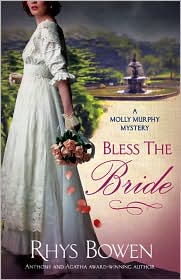
Rhys Bowen's Release Party, Bless the Bride

On March 1, Barbara Peters and the Poisoned Pen Bookstore hosted a champagne release party for award-winning author Rhys Bowen and her tenth Molly Murphy mystery, Bless the Bride. Everyone who attended was offered champagne or Guinness beer, Irish soda bread made by Barbara's husband, Rob Rosenwald, or fortune cookies. Fortune cookies? Continue reading.

While Peters said we were celebrating March 1 with the release of a Molly Murphy book, Rhys Bowen said it was also St. David's Day in Wales. While the conversation then took an unusual turn, covering everything from museum cards to Art Deco to New Zealand, we did end up back with Bless the Bride.

In Bless the Bride, Molly is approaching her own marriage. Rhys said over the years she's received tons of email from people saying, don't let her marry that nasty Daniel Sullivan.

Rhys said she wanted to examine brides in different cultures.  With all the immigrants in New York, Molly knows she's lucky to be able to make a choice as to who she is going to marry.  In the Jewish and Italian families there, women have no say as to who they will marry.

Although Bowen is half-way through the eleventh book, prior to the wedding Daniel  asked Molly to promise that she would give up the detecting business. At that time, if a woman worked, it would shame the man, appearing as if he couldn't support his wife. And, since Daniel is a police detective, it might jeopardize his career.  People would wonder if Molly was helping him with cases, or even interfering with them.

Molly is trying to sew her trousseau, and not doing very well with it. She has a request to work on a case, and she thought she'd take one last case because it would give her the money to buy the rest of her trousseau. 

A rich man's secretary approaches Molly asking her to find an object that was precious to him.  The rich man was a Chinese merchant, and it was a piece of jade that was precious. However, as Molly investigates, it turns out that piece of jade is worn by a woman, and she's the one that the merchant actually wants back. He bought her and had her shipped from China as a concubine.

Molly's cases are never easy morally. If she returns the woman to the man, she's returning her to virtual slavery. But, there's no place for the woman outside Chinatown. However, she has been hired by the client, and she owes her loyalty to him.  In the end, Molly decides not to touch the case, but by then events had been set in motion that couldn't be stopped.

Rhys told us she did extensive research on Chinatown. She loves doing research, and each book has called for different research. She has lived near the largest Chinese community in the country in San Francisco for forty years. The history of the Chinese in America is appalling. They had no rights. People wanted to send them home, but Congress had no money to do that. People could be very cruel to them. Many fled to the east, to Boston and New York. But, they didn't dare venture outside Chinatown. Because they looked different with their pigtail, they would be set upon. Why wouldn't they just cut the pigtail? Most of them hoped to return to China someday, but, if they cut their pigtail, they couldn't go back. In China, if a man didn't have a pigtail, it meant instant beheading.

A Chinese child could never become a citizen even if they were born in the U.S. The Chinese had no rights. The 1930 census of New York's Chinatown showed 3,000 men and 30 women. Men were doomed to be single. Some married Irish girls. They thought it was better to marry a China man who didn't drink than an Irish drunken lout. But, the couple who be shamed by both groups.

Chinese fathers valued education, so they sent their children to Catholic schools. Sometimes the children would be grabbed by missionaries who were trying to save them.

Some of the misconceptions about the Chinese were that they smoked opium, ate puppies, and stole little white girls.  However, they were terrible gamblers, which is why many of them didn't get ahead.

Rhys told us there were opium dens in Chinatown.  But, more non-Chinese men than you would think smoked opium. In 1903, there was tourism into Chinatown. Slumming tours were popular. A man named Chuck Conners led the tours, promising depravity and horror. He took people to fake opium dens, and women would swoon. Then they'd have a good meal in Chinatown to end the day.

Barbara Peters mentioned that Sherlock Holmes went into an opium den in one of the stories. And, S.J. Rozan writes about Chinatown today.

Bowen said Chinatown edges up to the Italian community. It's the next street up from Chinatown. In New York City, Chinatown is just three little streets. There's a huge community in San Francisco, but that Chinatown is also bordered on one side by the Italian community.

Rhys told us Molly is sewing her trousseau beside her future mother-in-law. Her mother-in-law has come around a little bit. Daniel's parents came over with very little, but they worked hard and were able to send Daniel to Columbia. They now mix with people of a higher echelon. They had hoped that Daniel would marry up. They're disappointed in Molly. She's one level down from Daniel. She came over from Ireland, and was really a peasant. Then Molly worked, and Daniel's mother was disappointed.

The eleventh book is in the works. The driving arc for so long has been Molly and Daniel. But, you can only carry that sexual tension on for so long. Now the conflict involves whether Molly will work on not. Rhys teased us, saying maybe Molly will end up helping Daniel on cases, going places he can't go, for instance, a convent.

Book eleven involves the cottages in Newport, Rhode Island, when Daniel and Molly are on their honeymoon. It involves the higher echelons of society. Bowen said it was time to bring Molly and Daniel out of New York City. This one deals with an Irish family made good, but they still will be shunned by the Astors and the Rockefellers.

When Rhys said Bless the Bride is set in September 1903, Barbara Peters said it's set before World War I changes the world, and nothing is the same. Peters worries about authors using that time period in their books. Rhys said her Lady Georgie mysteries are set prior to World War II, in the 1930s. The British think that silly little Hitler can't last. But, Bowen knows the war will happen, and so do her readers.

For a little while, the conversation went off course, covering The King's Speech, Gallipoli, the economy in Europe, and ending up with Irish subversives, and money funneled back to Ireland. But, we did end up back with Molly and Georgie.

September will bring a new Georgie book. She goes to the Riviera for the winter because that's where the upper-class British spent the winter. She goes with her brother, but she has a little assignment from the Queen. Georgie stays with her mother and Coco Chanel. Rhys said she's always asked where she gets her ideas. She knew she was sending Georgie to the Riviera, so she did research to find out who was there that winter. Coco Chanel was in her villa there. The Duke of Westminster was her lover. Coco Chanel held a fashion show that winter, and Queen Mary lent her niece jewelry to war at the show.

Rhys told us she met Queen Mary, and most of the royal family. Queen Mary was a small woman, with a rigid back. It was obvious no one messed with her. Rhys' father ran a paper factory, and she met all of the royal family at manufacturing shows when they would show up and go through the show.

Asked about the Constable Evans books, Rhys said they're on hiatus. She can't write three books a year. In addition, the publisher took quite a few of them out of print. There is on-again, off-again discussion of a possible TV series, but Bowen said she'll believe it when she sees it on TV. There is a possibility that St. Martin's will bring out an omnibus edition on e-books.

A lengthy discussion of e-books, and the process of publishing a book ended with comments about artwork. But, before signing books, Rhys Bowen said the next Georgie book will be Naughty in Nice. She wanted to called it Naughty But Nice, but the publisher's marketing team said that title wouldn't work. People wouldn't know how to pronounce it correctly, and would be embarrassed, so they wouldn't ask for the book.

Poisoned Pen Bookstore knows how to do a successful book launch, with champagne, snacks, and an author on hand to discuss the new book.  In this case, Rhys Bowen's Bless the Bride was released on March 1 to an appreciative audience.

Rhys Bowen's website is www.rhysbowen.com

Bless the Bride by Rhys Bowen. St. Martin's Press, ©2011. ISBN 9780312628109 (hardcover), 272p.

Kelli Stanley at the Poisoned Pen

If you ever have the chance to meet and listen to Kelli Stanley, grab it.  She's warm and friendly, and, talk about knowledgeable!  Anyone who is a fan of history would enjoy hearing her.  Before her presentation at the Poisoned Pen, a few members of Desert Sleuths had the chance to join her and her partner, Tana, for lunch.  Someone recently asked me what writers talk about when they get together.  Well, Kelli is a good example of all of the wonderful mystery authors I've met.  She encouraged everyone there to talk about what they're working on right now.  So, mystery writers talk about books, conferences, publishing. The ones I know are totally supportive of each other.

And, that discussion of publishing kicked off the program at the Poisoned Pen when owner Barbara Peters asked Kelli about a paperback of her first mystery, Nox Dormienda.  Stanley's second book in that series, The Curse-Maker, is out with a new publisher, St. Martin's Minotaur, and she was hoping they would release her paperback at the same time.  They said they wanted to wait to see how this book did.  In the meantime, Stanley is reworking that one to make it more accessible as a relaunch.

The subject of publishers brought up the recent bankruptcy filing by Borders.  Barbara said she's been interviewed a number of times, but actually the closing of stores won't affect Poisoned Pen too much.  They might gain a few customers, but it's not threat to the store. But, she said no one actually discusses the fact that the chain store business design is over in publishing. The problems at Borders and Barnes & Noble will definitely affect publishers.  Borders' problems, and problems with a Canadian distributor have created terrible problems for some publishers.

Kelli said, speaking of Barnes & Noble, a number of people important to authors have been let go there.  The mystery buyer and the Vice President of marketing are both gone. Some publishing is going to be driven to digital. Peters said there's going to be even more to lose as monoliths of publishing distribution fail because publishers designed their companies around them. She also said, speaking of e-book distribution, the Poisoned Pen website is being redesigned, and they will have e-book capability soon.

Before Barbara discussed Stanley's latest book, The Curse-Maker, she asked Patrick Millikin, the store's expert in noir, to talk about Kelli's last book, City of Dragons. Patrick said he liked the voice of the book.  It's a challenge to write about the '40s with a female protagonist, but Stanley got the voice right.  She also covered the social issues of the time.

Kelli thanked Patrick, and said feels it's important to discuss the social issues in her books.  Some of those same issues are relevant today.  Perhaps they are still important because, as a culture, we don't pay enough attention to history.

Stanley said she tries to be fair to the past.  She doesn't romanticize it.  The '40s did have wonderful art and creativity.  People were more gregarious. Entertainment was out of the home. People went to hear big bands. That was all part of the past. But, so was bigotry, and racism, sexism. Harassment and rape were facts of life, and something women were just supposed to put up with. Social conditions were appalling in some parts of the country, such as Appalachia. There was a lack of schooling and education in many areas. Brutality was accepted.

Kelli Stanley's character, Miranda Corbi, isn't an anomaly. She's modeled after reporter Martha Gellhorn. Gellhorn was Hemingway's third wife, but she would have hated to have been known that way. She was actually a better reporter than Hemingway. Stanley said City of Dragons is an homage to an idealistic generation that felt they could make a difference.

We all grew up with a censored version of the '40s, based on the movies.  But, the movies themselves were censored.  We can recognize the commonalities and differences between our times.

Patrick told Kelli he admired the way she turns the tables on the noir role of women, such as Brigid O'Shaughnessy as the evil temptress. Kelli said beautiful women are stigmatized in crime fiction of the '40s. She wanted to create a noir where the femme fatale is a hero. Miranda is strong, assertive, sexualized, beautiful, and a gumshoe. Asked if there would be more of Miranda, Stanley said yes. The second book, City of Secrets, is scheduled for a September release, just before Bouchercon. The first book did well, and she's writing the third Miranda now.

Kelli Stanley is actually on tour for The Curse-Maker, the sequel to Nox Dormienda.  It's a mystery set in Roman Britain, in Bath. The Romans were into spa tourism. Peters said it may have been the only time they were either warm or clean.

Peters said Bath is the one place you can see traces of the Roman city, the Georgian city of Jane Austen's world, and the modern city all in the same place. In fact, of all places, the Sally Lunn Historic Eating House & Museum have remains of the Roman, Medieval, Georgian and modern times all in the same place, the oldest house in Bath.

There are few mysteries set in Bath. Peter Lovesey lived there at one time, and set his Peter Diamond series there. But, the pollution is really bad there, and they have terrible weather inversions, so he moved.

Kelli said Bath was supposedly a pig wallow. Stanley was a scholar, getting a Masters degree in classics. Information about Bath was peripheral, but the combination of ancient cult, religion, and magic there excited her. She liked the idea of curses as part of religion and cult.

Cult was legal in Bath, but curses were frowned on. They were a way for the common people to control the uncontrollable. People would buy curses that were supposed to cause physical pain. Or, if you had a bet on a chariot race, you might buy a curse to be put on the favorite horse or chariot drive.

Kelli then gave us a scenario.  Let's say Barbara was at the spa without her servant. There were rituals there, the hot plunge, a cold plunge, bad poetry, food. It was like the malls, and people spent the whole day there. When Barbara came out, her favorite slippers were gone. So, she wanted to put a curse on the person who took the slippers. It's as if you filed a police report after a theft, and it would you feel better.

Bath was a little spa town, a tourist town. There wasn't much recourse for theft. Buying a curse was the equivalent of filing a police report. So the victim (Barbara) would go to the market, and find a curse-maker who would put a curse on the person who took the slippers.

Curse-makers were people who lived on the fringes, like carnies. They preyed on the desperate. There was an element of seediness about curse-makers.

Curses went into the channel to the deity, Sulis, the goddess of the spring where everyone went to get well. Curses were thrown into the sacred spring, along with an offering to Sulis. Then, people waited for the curse to come true. And, based on Kelli's research, this could be just as effective as reporting a theft to the police. The curse-maker would post a notification of the curse, and the person who took "Barbara's slippers" might think twice, and return them.  At which point, Barbara Peters said, see, publishing was the key element in a curse.

Bath was one of two places where curses were legal. They bound people to do certain things. Curses weren't legal in the rest of the Empire. Kelli said she was inspired to write about the curses when she was in England, and made a presentation at the University of London. She made a side trip to Bath, where she was allowed to touch curses and go behind the scenes at the Bath Museum.  Two items that were found in the sacred spring have puzzled people. One was a valuable bag of gemstones, including cut stones. The other was a tin mask. Stanley uses both of them in The Curse-Maker.

Kelli proceeded to show us a curse. They were usually made of lead, the metal of choice to reach the gods. Romans were polytheists, and they called on a number of gods to curse people, including Jesus. The better class of curse-makers would have extremely thin sheets of lead. Then they would use a stylus to write on it. Stanley didn't think they would allow her to bring lead on the airplane, so she used aluminum foil. She had an actual crucifixion nail to use as a stylus. Then the curse would be folded, and sealed with a binding curse. It would be bound by force to bind the deity to do the bidding of the curse-maker. That would fix the magic in place, and compel the deity. So, Kelli stabbed the nail through the curse.

The curse had to get to the hand of the god.  In places where there was not a sacred spring, people would go to a Roman graveyard, find a fresh grave, dig it up and put the curse in the hand of the body so it would get to the gods. There were grave curses against people who dug up corpses. In fact, Shakespeare had one on his stone, "Cursed be he that moves my bones."

Stanley's sleuth is a physician, Arcturus. Ruth Downie also has a series that features a Roman Britain doctor. Kelli said she uses a physician because that seemed the most logical person to get involved.  She needs a solid, logical reason for investigating.  At the time she had the idea, and wrote her first book, no one had done a Roman Britain doctor. Arcturus had been to war, so has seen sickness, death, and murder. He brings expertise to the investigation. Nox Dormienda was already written and accepted for publication when Ruth Downie's book came out. And, Kelli said she worried because her book was coming out from a small press, Five Star, while Downie, who was British, had J.K. Rowling's publisher. Then Nox Dormienda went on to win the Bruce Alexander Award for historical mystery.

Kelli said she was emphasizing style more than character because writers have to be able to say what sets your book apart. Nox Dormienda means A Long Night for Sleeping. It's in the noirish style, and a tribute to The Big Sleep.

Jane Finnis is another author who writes about Roman Britain. Her character is a woman, an innkeeper, and a refugee who fled Pompeii. Peters said since there was no police force in Rome, that period really doesn't have police procedurals.

Kelli Stanley said The Curse-Maker is lighter and funnier than City of Dragons. It's an homage to noir, not serious noir.

Stanley ended the program by reading from The Curse-Maker, setting the scene in the spa town of Bath. Arcturus is there because his wife seems to be in a state of deep depression, but he distrusts spa towns. They promised something they can't deliver, and those involved in spas prey on people.

As I said in the beginning, readers who have an interest in history might appreciate Kelli Stanley's books.  I know I'm looking forward to reading The Curse-Maker.  And, she even stamped the book with a blessing, "May good fortune bless and protect you always," and a stamp based on a picture she took in Bath of the image of the goddess Sulis.

Kelli Stanley's website is www.kellistanley.com

The Curse-Maker by Kelli Stanley. St. Martin's Minotaur, ©2011. ISBN 9780312654191 (hardcover), 320p.

Desert Sleuths with Kelli Stanley - Left to Right - Chantelle Aimee Osman, Kelli Stanley, Deb Ledford, R.K. Olson & Lesa Holstine

Cozy Authors at the Poisoned Pen

On Sunday, the Poisoned Pen had a wonderful turnout for a program featuring cozy authors.  Rhys Bowen, who acted as host, said now she knows the secret to marketing.  Promise cupcakes.  Bowen, the author of three series, Her Royal Spyness, Molly Murphy, and Evan Evans, was a terrific host.

Left to right - Hannah Dennison, Jenn McKinlay, Kate Carlisle, and Rhys Bowen


Rhys introduced the authors by saying they all are attractive women who kill people for a living.  And, their books make you chuckle and feel good.  She asked each author to introduce their characters.  Kate Carlisle's Brooklyn Wainwright is a bookbinder who does rare book restoration.  Every time she works on a book, someone dies.
Jenn McKinlay's current book features two friends, Mel and Angie, who own a cupcake bakery in Scottsdale's Old Town.  And, Jenn brought the cupcakes for the program.  They came from the cupcake bakery, Butter & Me.  And, Jenn was so pleased because they made the cupcakes look like the cover of her latest book, Buttercream Bump Off.                 

Hannah Dennison is the author of the Vicky Hill mysteries, set in England in Gipping-on-Plym.  And, bodies start off dead in Dennison's books because Vicky is an obituary writer.  Vicky is loosely based on Dennison's life in another century, when she worked as an obituary writer, and stood in church doorways taking down the names of the mourners.  Vicky's parents are criminals, wanted by Interpol, so she's not comfortable falling for policemen. 

Since Dennison's character was loosely based on her, Rhys Bowen asked Jenn and Kate if they were in their books.  Jenn said she and her sons made all the recipes in the back of her books, but a bakery life isn't for her since bakers have to be at work at 4 or 5 in the morning. 

Kate said she took lots of bookbinding classes, and she aspires to other aspects of Brooklyn's life.  She took everything she loves and put it in the books.  Brooklyn lives in San Francisco, and Carlisle loves that city.  Her character was raised in a commune in Sonoma where the members grew grapes, and eventually became wealthy due to their winery.  And, of course, Kate has to do hours of research.  So, her books include wine, San Francisco and books.

Rhys said she loves the research.  The last book in Her Royal Spyness series is set in Nice, so she had to go there and spend two weeks checking out the city and the bistros.  So, Kate's an author after her own heart.

Bowen asked the authors to tell the audience about their latest book.  McKinlay's Buttercream Bump Off is the second book in the series.  She laughed and said one reader complained they knew who the murderer was too soon, and Jenn said she couldn't remember who it was.  She wrote the book a year ago.  It's the second adventure for Mel and Angie.  Mel's mother, Joyce went on a date, and her date dies.  It was her first date in thirty years.  She blamed her dress, but the police suspect Joyce.  So, Mel and Angie have to find out who really killed him.


Hannah Dennison said her books feature unusual British pastimes.  The fourth one is Thieves!  Morris dancing, based on folklore, is important to the plot.  In the book, there is a Morris dancing danceathon, an annual event at the Grange.  Gypsies camp there, and someone dies.  As an aspiring investigative reporter, Vicky Hill works on the case.  (Dennison said she wanted to be an investigative reporter when she was writing obituaries.            

The Lies That Bind is the third book in Kate Carlisle's series.  Brooklyn
Wainwright is back in San Francisco teaching a class in bookbinding.  But, the artistic director of the center is horrible, so she has to die.  There's a book within the book.  Oliver Twist sets the story going.  The center has a Twisted Festival to raise money, and there is a band of thieves as in Oliver Twist.

Rhys Bowen said, oh yes, it's very therapeutic to kill off people you don't like.  Then, she said Kate had a background in TV.  She wrote for The Gong Show.  Bowen asked if Carlisle had thought about writing screenplays.  Kate said she did try to be a screenwriter, but it's much harder.  She needed more stuff to go on than could in a screenplay.  She went to law school, for one year.  Then she started writing and killing off truly evil professors.

Bowen said Jenn McKinlay writes a few series, which is why she has a hard time remembering her killers.  Jenn said she has loads of personalities.  As Lucy Lawrence, she wrote the decoupage series.  The last book in that series will be out in March.  It wraps up the series.  Jenn said that's OK because it was a perfect three book series.  It looks like the cupcake series, written as Jenn McKinlay will be going for a while, at least until people get tired of cupcakes.  And, she's launching the Library Lover's Mystery series, set in Connecticut, where she grew up and got her degree.  As Josie Bill, a third identity, she'll write a thrift series.  Jenn said she's Scottish and cheap, so she loves thrift.  She said there will be thrift tips in the books.

Bowen, like Dennison, was from England, so she asked Hannah if she could only write about England after she left.  Hannah said she couldn't wait to leave England for California.  Then the only stories she could tell were about the place she left.  Devon, where she sets her books, is fifty years behind the world, in a simpler time.  The books have weird backdrops, some her editor discovered.  They've featured snail races and hedgejumping.  Hedgejumping is not done on horseback.  It's a serious hobby.  Hannah learned a lot eavesdropping on a conversation in a bump when a woman told her husband he had to stop stopping the car to jump hedges.  Rhys agreed that there were unusual hobbies there, mentioning the man who was the last mud sled fisherman in England, taking a sled out on mud to catch shrimp.

The authors were all asked how they managed an outside work life and writing.  Carlisle said she quit working in July.  She had worked for lawyers.  She wrote for three hours before going to work at 8:30, and on weekends.  She was determined to keep writing, despite hundreds of rejections.  She said you learn by writing.

Jenn has a part-time job at the Central Library in Phoenix.  She's afraid to leave and lose her material.  When Buttercream Bump Off made the extended New York Times Bestseller list, everyone at the library asked if she was going to leave.  She didn't know where she'd get her material if she left.

Hannah is working for an advertising agency, for the chairman.  She said it's crazy there.  She writes beofre work, and gets up at 4:30.  She wants to transition into writing full-time, but the stories in advertising are so good.

Rhys said the all write cozies, a term she finds insulting.  How did they feel about that term?  Kate answered that she also writes romance, so cozies are a step up for legitimate writing.  She wrote murders for years, and didn't know what a hook is.  Now, she knows what a hook is, and that she's in the right place.  She's happy where she is.

Jenn also came from romance.  She wrote a few Harlequins.  She tells the story that her husband doesn't sleep at night, knowing she's better at writing murders than romance.  She said Agatha Christie is a cozy writer, so I'm fine with it.  She's not a thriller writer.  And, she said, it depends who says "cozy."  If it's one of the boys, it's usually denigrating.  But, a reviewer who says it's a wonderful cozy and the characters kick, means cozy is fine.

Hannah said she's warped.  She really likes murdering people, and she wants to make it funny.  She wants to write an escape from reality, so people can enjoy it with chocolates and cats.

Rhys Bowen said cozy writers see society as a complete whole, and, if murder happens, it disrupts the whole.  The sleuth puts the world back again.  Noir writers see the whole world as warped, and they only put a piece of the world back in place.

They were asked how they manage to maintain their relationships with writing and working.  Jenn had the best answer.  "My husband's a musician, so I look good."  Kate said her husband is supportive, and even does all the shopping.  Hannah said her husband feels as if she's physically not there since she's at work, or mentally not there since she's writing.  He drifts around her orbit.  Actually, he's a copywriter and writes screenplays, so they're permanently tormented together.

Then they were asked how they write such realistic, three dimensional characters.  Jenn said hers are composites.  They are her and every best friend she's had.  She's been lucky to always have a buddy.  Buddies are good because everyone has insecurities and flaws.  It's the buddy that makes everything OK.
Hannah said Vicky is her, young and insecure.  She was a freak at school.  But, she loves watching people.  She takes a character and takes them to the extreme.  Her unusual, quirky characters are based on people who really exist.  Kate said, "Brooklyn is a little younger, taller, small, deeper, and more heroic me."  Kate was a loner whose family moved a lot.  She lived in her own head.  So Brooklyn has friends, and a strong sense of justice.  Carlisle said her books are so character driven that the plot falls by the wayside.  She's all about the character.  When someone asked about Brooklyn's archenemy, Minka, Kate said she's bubonic plague for books.  Carlisle knew someone like that when she was working in TV.

When they were asked who their favorite authors were, Hannah said, "Rhys Bowen, Kate Carlisle, Jenn McKinlay."  Then she said, and of course, Agatha Christie.  Jenn agreed with Agatha Christie, but added that she has eclectic taste since she works in a library.  She doesn't read many mysteries.  Since she's working with young adults, she reads YA books.  She said there's really good stuff there.  Teen is an incredible market, with people open to everything.  They're looking for unique voices and unique stories.  The books are more cutting edge in the YA market.  They're not looking for a hook as much as a unique story.

Kate said she reads, Rhys, Hannah, Nancy Martin's Blackbird Sisters mysteries.  She reads Juliet Blackwell.  She loves her witch books, and the Art Lovers books.  She loves the two men fighting over the character in the Art Lovers mysteries.  Speaking of two men, she reads Janet Evanovich.  Then there are Sue Grafton and Sara Paretsky, the godmothers of the genre.  Carlisle reads mysteries and romance.

So, Rhys said, OK, speaking of romance; how much sex is in your books?  Jenn's books don't have much sex.  She doesn't like scary or noir.  She likes cozies because they just hint at sex.  Dennison's Vicky will not have sex, and it's unlikely she ever will.  The editor doesn't want her to.  Like Hannah herself, Vicky is a late starter.  Vicky is obsessed with getting a front page scoop, as Dennison was.  If Vicky does have sex, it will just be to get it out of the way, as Hannah's mother advised her to do. 

Kate's Brooklyn met a man, is happy now, and the relationship has progressed.  Mystery readers aren't always interested in seeing everything on the page.  So, Carlisle either closes the door or the couple is interrupted.  But, the fourth book in the series features an antique copy of the Kama Sutra.  Rhys called out, "More research!"

Hannah had mentioned that the Vicky Hill mysteries were probably not going to continue here, but she has sold more books in that series in the U.K.  Asked about more odd hobbies, she said one will feature tar barrel racing.  On Nov. 5, they hold races.  The barrels are filled with tar, and then there are separate races for men, women and children.  They run holding the barrel aloft with one glove, like a cooking mitt.  Rhys and Hannah agreed that when you move away from home, you get nostalgic for the time, not the place, but you never feel at home again.

When Rhys asked what was coming next, Kate Carlisle said the Kama Sutra mystery is called Murder Under Cover.  There's danger between the sheets.  Jenn's next cupcake mystery is Death by the Dozen, scheduled for October.  She was inspired by the Scottsdale Food Festival.  There's a challenge for the chefs, and Mel and Angie enter the desserts competition.  Mel's mentor from the Scottsdale Culinary Institute is murdered, so naturally, they become involved.  Hannah said if she has to tie the series up, she'll make sure Vicky has sex.  Maybe she'll run a quiz, and have people write in and suggest the lucky man.

Rhys Bowen's next book is due out March 1, Bless the Bride.  It's a Molly Murphy mystery.  Molly has promised Daniel she won't investigate cases after the wedding.  But, just before the wedding, she becomes involved in one in New York's Chinatown.  The next book in Her Royal Spyness series is set in Nice.  It will be called Naughty in Nice.  And, it features Coco Chanel, the Duke of Westminster, and jewels that were lent to Queen Mary. 

Once again, the Poisoned Pen presented a fun author program, complete with cupcakes.

Hannah Dennison's website is http://www.hannahdennison.com/

Jenn McKinlay's website is http://www.jennmckinlay.com/

Kate Carlisle's website is http://www.katecarlisle.com/

Rhys Bowen's website is http://www.rhysbowen.com/